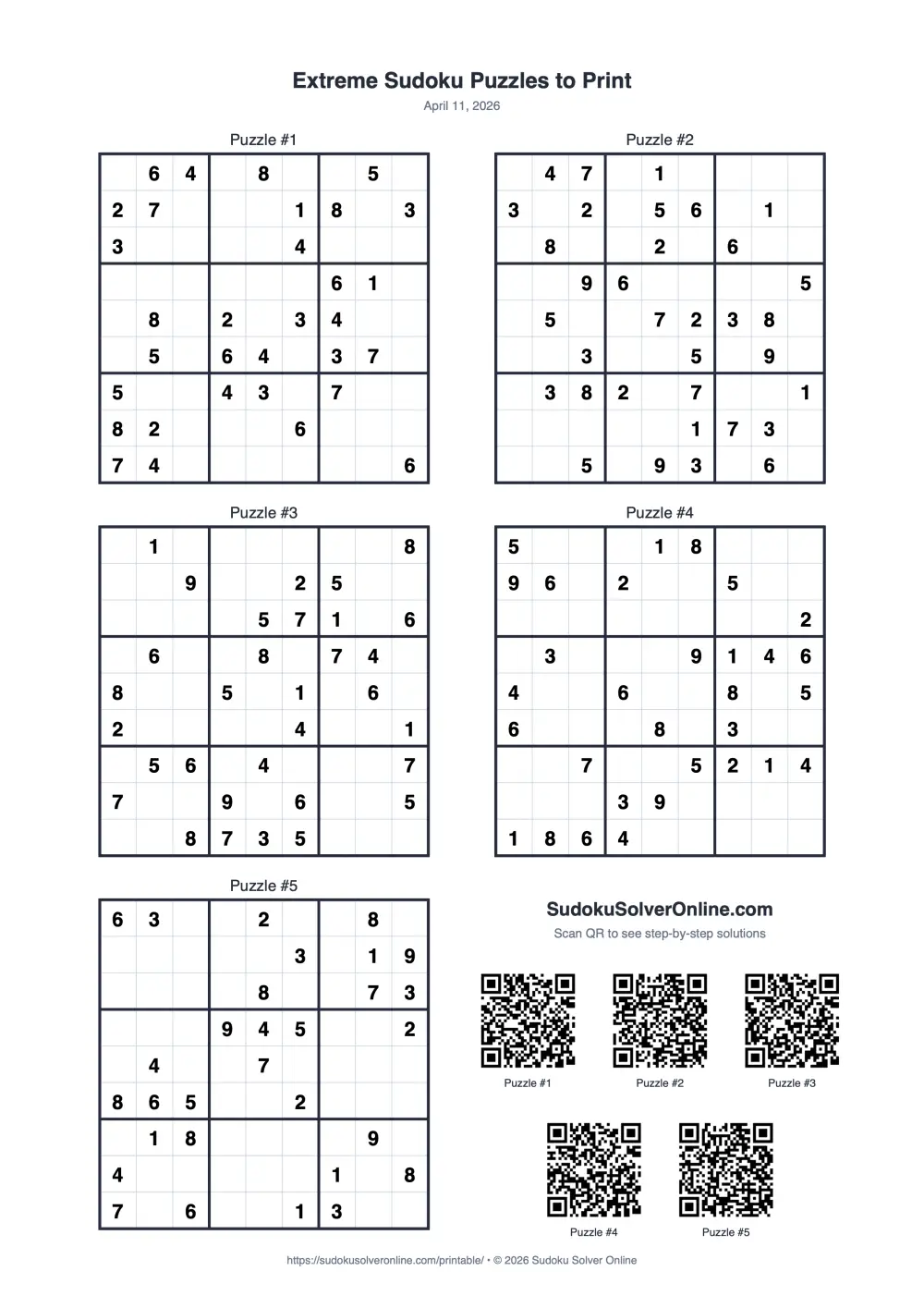
Extreme Sudoku — Testing the Limits
Extreme puzzles are where conventional strategies start to reach their boundaries. These grids demand chain-based reasoning — following a candidate through a sequence of logical implications to prove or disprove its placement. Only experienced solvers with a deep understanding of Sudoku logic should attempt these.
What Makes a Puzzle "Extreme"?
Extreme grids are designed to require the most sophisticated elimination techniques:
- Simple Coloring — Assigning alternating colors to strong links of a single candidate to identify contradictions or eliminations.
- X-Cycles — Continuous and discontinuous cycles along single-candidate chains that yield powerful eliminations.
- XY-Wing — A pivot cell with two candidates connecting to two wing cells, creating eliminations where the wings overlap.
- XYZ-Wing — An extension of XY-Wing with three candidates in the pivot cell.
- 3D Medusa — Multi-candidate coloring that tracks implications across different numbers simultaneously.
Who Are Extreme Puzzles For?
- Elite solvers who have exhausted simpler pattern-based techniques.
- Logic enthusiasts who enjoy chain reasoning and proof-by-contradiction.
- Learners of coloring techniques who want real-world practice puzzles.
Tips for Solving Extreme Sudoku
- Learn coloring — start with Simple Coloring on a single digit. If both colors appear in the same unit, one color is eliminated everywhere.
- Trace chains carefully — one wrong link invalidates the entire chain. Be methodical.
- Look for XY-Wings — a Y-shaped pattern of three bivalue cells is surprisingly common once you train your eye.
- Take breaks — Extreme puzzles can take 45+ minutes. Fresh eyes often spot what tired ones miss.