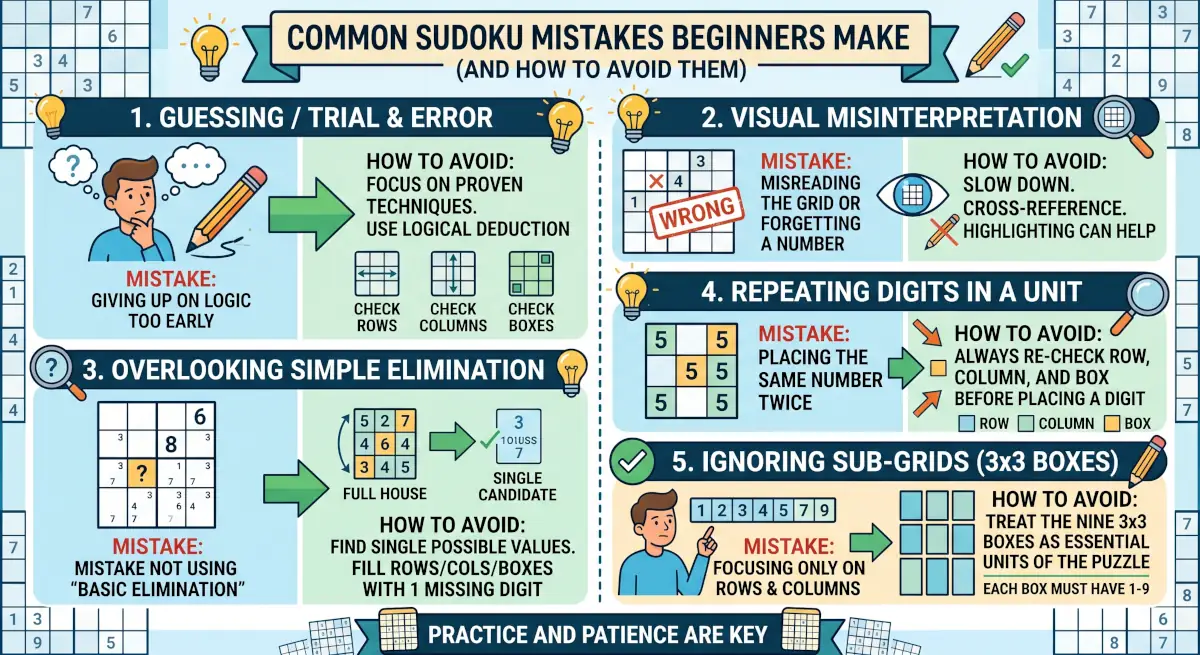
When you first start playing Sudoku, it is completely normal to make mistakes.
Sudoku looks like a game about numbers, but it is actually a game about patterns and logic. Because of this, many new players fall into the same common traps. A single wrong move can ruin your entire progress, forcing you to erase your work and start over.
In this guide, we will look at the most common Sudoku mistakes beginners make and explain exactly how to avoid them.
1. The Biggest Trap: Guessing
Many beginners get stuck and decide to guess. They look at an empty cell and think:
"A 5 looks like it fits here. I will just write it down and see what happens."
This is the most common mistake in Sudoku.
Why It Fails
Sudoku is a chain reaction. Every number you place affects other cells in the same row, column, and 3×3 box. If you place a wrong number, you might not notice it immediately. But ten moves later, you will find yourself in a corner with no legal moves left. Finding where you made that original mistake is almost impossible.
How to Avoid It
Never guess. Only place a number when you have absolute, logical proof that it belongs in that cell. If you cannot explain why a number goes somewhere, do not enter it. Instead, look at another part of the board.
2. Forgetting the "Three-Way Check"
A classic beginner mistake is looking at a row and column, but forgetting to check the 3×3 box (or vice versa).
Why It Fails
Imagine you are looking at a cell. You see that the number 4 is missing from its row and column, so you write it down. However, there is already a 4 in the 3×3 box. Your move is incorrect, and you have broken the rules of the puzzle.
How to Avoid It
Before entering any number, perform a strict Three-Way Check: 1. Is the number already in the row? 2. Is the number already in the column? 3. Is the number already in the 3×3 box?
Only enter the number if the answer to all three questions is No.
3. Scanning the Grid Aimlessly
When looking at a fresh Sudoku board, the 81 empty cells can feel overwhelming. Many beginners let their eyes wander randomly across the grid, hoping to spot a number.
Why It Fails
Aimless scanning is slow and exhausting. You will miss easy numbers right in front of you because your brain is trying to look at everything at once.
How to Avoid It
Be systematic. Focus on one element at a time: - Scan nearly-full rows or columns: If a row has 7 or 8 numbers filled, it is extremely easy to find the missing ones. - Use cross-hatching: Focus on a single number (like 1) and scan the rows and columns containing 1 to see where it is blocked in other boxes. - Work through boxes 1 to 9: Go box by box, checking if you can place any missing numbers.
4. Underusing Pencil Marks (Mental Overload)
As you move from Easy to Medium puzzles, you will reach a point where you cannot hold all the possibilities in your head. Beginners often refuse to write down notes, trying to solve everything mentally.
Why It Fails
Your working memory can only hold a few details at once. Trying to remember that a cell can be a 2, 5, or 8 while analyzing another part of the board leads to mental fatigue and mistakes.
How to Avoid It
Use pencil marks (also called candidate notes). Write tiny numbers in the corners of empty cells to show which values are possible.
The simplest technique that uses pencil marks is the Naked Single. When only one candidate remains in a cell, you can place that number immediately.
5. Overusing Pencil Marks (The Messy Grid)
The opposite of underusing notes is writing down too many of them. Some players write down every possible number in every single empty cell from the very start.
Why It Fails
A grid filled with hundreds of tiny numbers becomes messy and hard to read. You will suffer from "information overload" and fail to see simple, obvious moves because of the visual clutter.
How to Avoid It
- Solve the easy, obvious numbers first without pencil marks.
- Only start writing pencil marks when you get stuck.
- Keep your notes clean by updating them. Every time you place a real number, erase that number from the pencil marks of all neighboring cells in the same row, column, and box.
6. Overlooking the "Hidden Single"
Beginners often focus entirely on what numbers can fit into a specific cell. They forget to look at where a number must go within a whole row, column, or box.
Why It Fails
You might look at a cell and see that it could contain a 2, 3, or 7. You move on, thinking you cannot solve it yet. But if you look at the wider row, you might discover that this cell is the only place in the entire row where a 7 can legally go!
This is called a Hidden Single.
How to Avoid It
Instead of only asking:
"What numbers can fit in this single cell?"
Also ask:
"Where is the only place the number X can go in this row/column/box?"
Summary of Good Sudoku Habits
To avoid these common mistakes, build these simple habits into your daily play:
- Go slow: Take five extra seconds to double-check a number before you write it down.
- Keep it clean: If you use pencil marks, update them immediately after placing a number.
- Stay calm when stuck: If you cannot find a move, do not guess. Take a short break, or change your focus to a different part of the grid.
- Learn the logic: The more strategies you know, the less you will feel tempted to guess.
By changing a few simple habits and avoiding these classic traps, you will build your confidence, solve faster, and enjoy the true, logical beauty of Sudoku.
Common Questions
What should I do if I realize I made a mistake?
If you find a duplicate number or get stuck with no moves, do not try to patch it up. It is usually best to erase your recent moves back to the point where you were absolutely sure of every placement, or simply restart the puzzle with a fresh mind.
Is it cheating to use pencil marks?
Not at all! In fact, solving harder Sudoku puzzles is almost impossible without pencil marks. Even the world's best players use them. Think of them as a useful tool for organizing your logical thoughts.
How do I know if a puzzle requires guessing?
A properly constructed Sudoku puzzle never requires guessing. Every valid puzzle has exactly one unique solution that can be reached using pure logic. If you feel forced to guess, you have either made a mistake earlier or missed a logical clue.
Ready to Level Up?
Now that you know how to avoid the most common beginner mistakes, you are ready to learn real solving strategies. Explore our guides to master:
- Naked Pairs — how finding two identical candidates in a unit helps you eliminate other notes.
- Intersection Removal — how boxes and rows interact to eliminate possibilities.
- X-Wing — a powerful strategy for cracking advanced puzzles.
Happy solving!