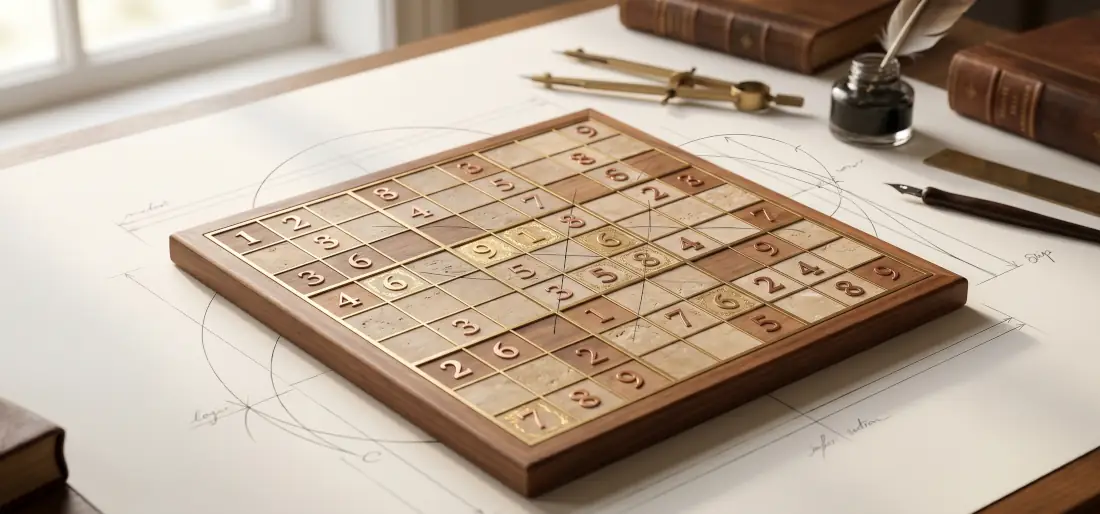
Watching an expert solve an extremely difficult Sudoku puzzle can feel like watching a magic show. Their fingers fly across the grid, placing numbers in what seems like seconds, solving puzzles that would leave most beginners completely stuck.
But expert players do not have supercomputers for brains, nor do they possess secret math skills.
Instead, they have trained themselves to see the grid differently. They use a specific set of mental habits, scanning routines, and pattern-recognition techniques that turn complex logic into second nature.
In this guide, we will step inside the mind of a master and explore the exact ways expert Sudoku players think — and how you can apply these habits to your own games.
1. They Scan for Relationships, Not Just Empty Cells
When a beginner looks at a Sudoku grid, their eyes usually search for empty cells. They ask themselves: “What number goes in this specific blank box?”
Experts do the exact opposite. They look at the relationships between the numbers that are already on the board.
How they think
Instead of analyzing individual squares, an expert scans the intersections where rows, columns, and 3×3 boxes meet. They look for: * Shared lines: How a number in box 1 and box 2 restricts where that same number can go in box 3. * Intersection conflicts: How a number missing from a row is blocked from certain spots because of the boxes it passes through.
By focusing on how numbers interact across the grid, experts can spot placements that beginners completely overlook.
2. They Focus on "Negative Space"
Beginners focus heavily on positive space — the numbers that are present. Experts are masters of negative space — they focus on what is missing and where it cannot go.
How they think
When an expert looks at a nearly empty box, they don't see random blanks. They see walls and blocks.
If they are looking for where the number 7 belongs, they trace invisible "beams" of blockades across the rows and columns that already contain a 7. They look for the cells that are not blocked. By eliminating the impossible areas, the correct cell naturally reveals itself.
3. They Use Highly Structured Pencil Marks
For intermediate and hard puzzles, writing down candidate numbers (pencil marks) is essential. However, while beginners often write down notes randomly or fill the grid with clutter, experts are incredibly disciplined.
Many masters use a technique called Snyder Notation: * They only write down pencil marks in a 3×3 box if a candidate has exactly two possible locations in that box. * If a number could go in three or four places, they write nothing.
How they think
This strict rule prevents the grid from becoming messy. If they solve one of those two cells later, they instantly know the other cell must be the second pencil mark. This clean, binary way of thinking makes their solving process fast and mistake-free.
4. They See Patterns as "Chains"
To a beginner, every number placement is a separate event. To an expert, every move is a link in a logical chain.
How they think
When an expert places a number, they don't celebrate and look for something new. Instead, they immediately ask:
“What did that placement just change?”
Every new number removes possibilities from its row, column, and box. The expert instantly follows the "ripples" of their move: 1. They place a 4 in box 5. 2. They immediately scan box 4 and box 6 to see if this new 4 helps place another one. 3. They check the row and column they just modified to see if any Naked Pairs or Naked Singles were created.
5. They Think in "Sets" (Pairs, Triples, and Quads)
As puzzles get harder, single numbers become difficult to place directly. Experts adapt by looking for groups of numbers instead of individual ones.
How they think
They look for groups of two or three cells that share the same candidates: * Naked Pairs: If two cells in a row can only contain the numbers 2 and 7, the expert knows those two cells "lock" those numbers. Even if they don't know which cell is which, they know 2 and 7 cannot go anywhere else in that row. * Locked Candidates: They see how a row missing a number forces that number to be inside a specific box, allowing them to eliminate it from other parts of the grid.
By thinking in groups and sets, they can eliminate dozens of impossible candidates at once, cracking open even the most stubborn grids.
6. They Stay Patient and Welcoming of "Roadblocks"
When a beginner gets stuck, they often feel frustrated, which tempts them to make a random guess.
When an expert gets stuck, their mindset is completely different:
“I am stuck, which means there is a beautiful, advanced pattern hidden here waiting to be found.”
How they think
Experts welcome roadblocks. Getting stuck is simply a sign that the basic techniques (like cross-hatching) have done their job, and it is now time to use more advanced logical tools. They systematically scan for patterns like X-Wing, Hidden Pairs, or Intersection Pointing with patience and curiosity.
Train Your Brain to Think Like an Expert
You can start training your brain to think like a master today by adopting these simple habits:
- Be systematic: Scan row-by-row and box-by-box rather than jumping around randomly.
- Track the changes: Every time you enter a number, trace its effects immediately.
- Practice Snyder notation: Keep your pencil marks limited and clean.
- Trust the logic: Never guess. If you are stuck, accept it as a fun challenge to find a hidden pattern.
With time, patience, and structured training, you will start seeing the grid through the eyes of an expert. To accelerate this progress, learn our guide on how to practice Sudoku efficiently to build your logical scanning speed and find the hidden threads of logic that make Sudoku one of the most satisfying puzzle games in the world.
Common Questions
Do expert Sudoku players solve puzzles entirely in their heads?
Only on easy and medium puzzles. On hard, expert, and extreme puzzles, keeping track of all the interactions is visually impossible. Experts rely heavily on structured pencil marks to keep track of candidates and isolate patterns.
How long does it take to learn expert techniques?
You can understand the theory behind advanced techniques (like Naked Pairs or X-Wings) in just a few minutes. The real skill is learning to spot them on a messy board, which comes with regular daily play and practice.
Is it better to focus on speed or accuracy?
Always focus on accuracy and logical reasoning. Speed is simply a natural byproduct of pattern recognition. The more puzzles you solve accurately using pure logic, the faster your brain will recognize those same patterns in future games.
Test Your Expert Focus Now
Put these expert habits to the test. Choose a difficulty level and practice thinking systematically, tracking ripples, and scanning relationships:
- Play Sudoku — Great for practicing fast, systematic scanning without notes.
Happy solving!