Sudoku is one of the most popular puzzle games in the world. Millions of people solve daily grids on their phones, in morning newspapers, or in dedicated puzzle books.
Because of its name, many people assume that Sudoku is an ancient Japanese game that has been played for thousands of years.
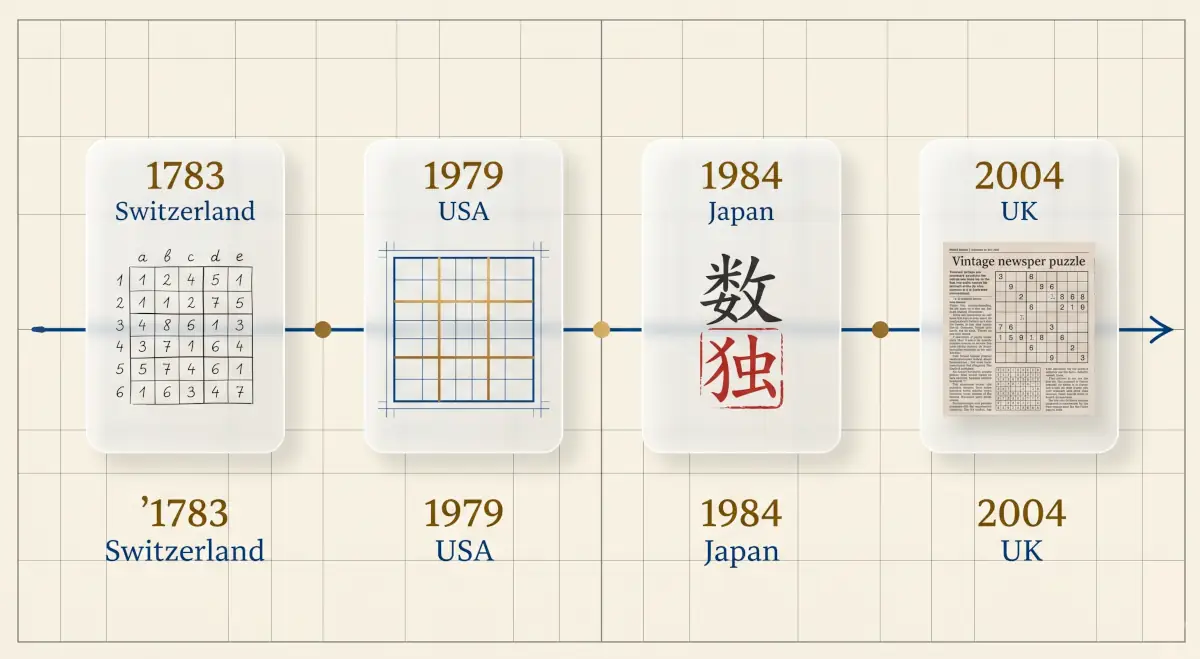
However, the real story is much more surprising. The history of Sudoku is a fascinating, 200-year journey that crosses three continents — Europe, North America, and Asia — and involves brilliant mathematicians, anonymous architects, and a retired judge.
Here is the global history of how a simple math theory became a worldwide puzzle phenomenon.
1. Switzerland: The Math Origin (1783)
The absolute foundation of Sudoku was created in the 18th century by a Swiss mathematician named Leonhard Euler.
Euler, who was one of the greatest mathematical minds in history, designed a puzzle called Latin Squares.
What is a Latin Square?
A Latin Square is a grid where every number or symbol appears exactly once in each row and each column.
While this sounds exactly like the first two rules of modern Sudoku, Euler’s puzzle had one major difference: it did not have the 3×3 box restriction. Euler designed this purely as a mathematical exercise, and it remained a tool for scientists and mathematicians for nearly two centuries.
2. France: The First Newspaper Grids (1892)
In the late 19th century, French newspapers began playing with Euler’s Latin Squares to create fun games for their readers.
In 1892, the French newspaper Le Siècle published a weekly puzzle that required readers to fill in missing numbers in a 9×9 grid using logic. A few years later, in 1895, another newspaper called La France modified the game so that it used the numbers 1 to 9, similar to modern play.
These games were incredibly popular in Paris, but the craze was cut short by the outbreak of World War I. The puzzles disappeared, and the game lay forgotten for decades.
3. United States: The Birth of the 3×3 Grid (1979)
The modern Sudoku grid as we know it today was born in Indianapolis, USA, in 1979.
An 74-year-old retired architect and puzzle designer named Howard Garns took Euler’s Latin Squares and made a brilliant addition: he divided the 9×9 grid into nine 3×3 boxes.
He named his new puzzle Number Place and published it in Dell Pencil Puzzles & Word Games.
A quiet invention
Garns did not sign his name to the puzzles, so he remained anonymous for years. Sadly, he passed away in 1984, just before his quiet invention took over the world. Today, he is widely recognized as the father of modern Sudoku.
4. Japan: The Catchy Name is Born (1984)
In 1984, the Japanese publisher Maki Kaji, head of the puzzle company Nikoli, spotted Garns’s "Number Place" in an American magazine and fell in love with it. He brought the game to Japan, but felt the English name was too plain.
He renamed the puzzle with a long Japanese sentence: Suji wa dokushin ni kagiru, which literally translates to:
“The digits must remain single (unmarried).”
Because that name was far too long, it was quickly shortened to just two characters: Su (meaning digit) and Doku (meaning single).
And just like that, the word Sudoku was born!
Nikoli refined the game by introducing two key rules that experts still love today: 1. Puzzles must have symmetrical clue patterns. 2. The initial clues must be limited, leaving a clean, beautiful board.
5. London: The Global Explosion (2004)
Sudoku was a massive hit in Japan, but it remained a local secret for twenty years. That changed because of a retired New Zealand judge named Wayne Gould.
In 1997, while visiting a bookstore in Tokyo, Gould discovered a Sudoku book. Although he didn’t speak Japanese, he quickly realized how the logic worked.
Gould spent the next six years writing a computer program that could instantly generate unique Sudoku puzzles. In 2004, he traveled to London and convinced the editors of The Times newspaper to publish a daily puzzle.
The British public went crazy for it. Within weeks, every major newspaper in the UK had its own daily grid. By 2005, the craze had swept across Europe, the United States, and back around the globe, creating a massive puzzle boom. This explosion of interest ultimately paved the way for international competitions, including the prestigious World Sudoku Championship.
Today: A Universal Logic Language
Today, Sudoku is played by hundreds of millions of people on every continent.
Because it uses numbers, people often worry they need math skills. But as its history shows, Sudoku was designed as a language of pure, universal logic. You could solve a grid using letters, colors, or symbols, and the rules would remain exactly the same.
From a 18th-century Swiss math theory to modern digital solvers, Sudoku continues to keep minds active, focused, and healthy worldwide.
Common Questions
Who invented Sudoku?
The modern game was designed by Howard Garns, an American architect, in 1979 under the name "Number Place." However, the core concept was based on "Latin Squares," created by Swiss mathematician Leonhard Euler in 1783.
What does the word "Sudoku" mean?
"Sudoku" is a Japanese abbreviation. It comes from the phrase Suji wa dokushin ni kagiru, which means "the digits must remain single."
Is Sudoku a math game?
No. While it uses numbers, there is no arithmetic, addition, or math involved. The numbers are simply symbols used to represent nine distinct values.
Ready to Join the History of Solvers?
Start your daily logic session and keep your brain healthy with the world's favorite puzzle. Choose your preferred game level:
- Play Sudoku — Join millions of daily solvers and tackle your next grid right now!
Happy solving!