For most of us, Sudoku is a quiet, relaxing hobby. We solve a grid with our morning coffee or use it to unwind before going to sleep.
However, in the wider puzzle community, Sudoku is also a highly competitive, high-pressure international sport.
Every year, the world's most brilliant logic minds gather at the World Sudoku Championship (WSC) to race against the clock, face mind-bending puzzle variants, and compete for the title of World Champion.
In this guide, we will explain exactly how the World Sudoku Championship works, the types of puzzles competitors face, and how you can apply tournament habits to your own daily games.
What Is the World Sudoku Championship?
The World Sudoku Championship is the official international tournament for Sudoku solvers.
It has been organized annually by the World Puzzle Federation (WPF) since 2006, when the first championship was held in the historic city of Lucca, Italy. If you are interested in how the game evolved before it became an international sport, check out the complete history of Sudoku.
Every year, a different host country welcomes national teams and individual solvers from over 30 countries — including Japan, the United States, Germany, India, and China. Competitors range from teenagers to retirees, all united by a passion for pure logic.
How the Championship Works
The WSC is a two-to-three-day test of mental endurance. Competitors do not play on phones or computers; every puzzle is solved using pencil and paper.
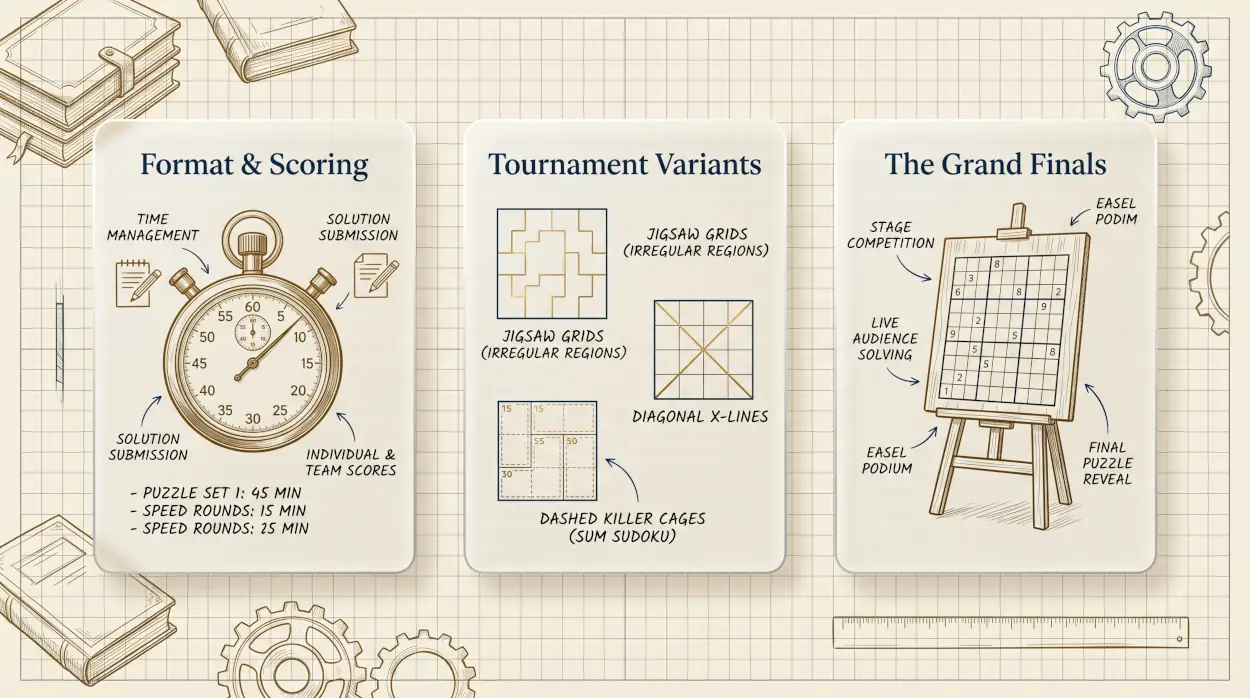
The tournament is divided into multiple themed rounds: * Strict Time Limits: Each round lasts between 30 to 60 minutes. * Point Systems: Points are awarded for each correctly solved puzzle. * Speed Bonuses: If a player completes all puzzles in a round before the timer runs out, they receive a "time bonus" point for every remaining second. * Accuracy Rules: Careless mistakes are heavily penalized. A single wrong number or a duplicate in a row can reduce a puzzle's score to zero.
Puzzles Faced: The Rise of Variants
If the championship only used classic, standard 9×9 grids, the top solvers would finish them instantly. To challenge the world's best, the WSC features a massive variety of Sudoku variants.
In fact, classic Sudoku usually accounts for only a small percentage of the total score. To win, champions must master variants such as:
1. Irregular (Jigsaw) Sudoku
In this variant, the standard 3×3 boxes are replaced by irregular, wiggly shapes. Solvers must adapt their visual scanning because the borders of the units are constantly changing.
2. Diagonal (X-Sudoku)
In addition to the standard rows, columns, and boxes, the two main diagonal lines (forming a giant 'X' across the board) must also contain the numbers 1 through 9 without repetition.
3. Killer Sudoku
This popular variant features dashed-line "cages" within the grid. Each cage contains a small number indicating the sum of all digits inside that cage, combining logic with simple arithmetic.
4. Consecutive & Non-Consecutive Sudoku
In Consecutive Sudoku, all neighboring cells that contain consecutive numbers (like 3 and 4) are marked with a line or dot. In Non-Consecutive Sudoku, no neighboring cells anywhere on the board can contain consecutive numbers, which adds a complex layer of elimination.
The Grand Finals: The Live Showdown
At the end of the general rounds, the top individual competitors enter the high-pressure Grand Playoff.
This is the ultimate live showdown: * Competitors solve giant Sudoku puzzles printed on large vertical easel boards standing on a stage. * They solve in front of a live audience of spectators and cameras. * They must stand up, coordinate their visual scanning, and write physically while under intense pressure. * The first player to correctly complete all their playoff boards is crowned the official World Sudoku Champion.
Legendary Champions
Over the years, a few solvers have dominated the WSC, demonstrating incredible consistency and cognitive speed: * Kota Morinishi (Japan): The most successful competitor in WSC history, with four individual World Champion titles (2014, 2015, 2017, and 2018). * Thomas Snyder (USA): A legendary three-time individual World Champion (2007, 2008, and 2011) known for his extreme speed and highly structured visual scanning routines. * Jan Mrozowski (Poland): Another three-time consecutive individual World Champion (2009, 2010, and 2012).
How to Train Like a World Champion
You don't need to travel to the world championships to start training like a pro. You can build champion habits at home:
- Prioritize Accuracy First: Tournament players know that an incorrect puzzle yields zero points. Train yourself to never enter a number unless you are 100% logically certain. Double-check your placements.
- Practice Under a Timer: Try starting a timer on your phone when playing. This builds mental resilience, teaches you to ignore distractions, and increases your pattern-recognition speed.
- Explore Puzzles and Strategies: Don't stick to easy routines. Challenge your brain by moving to Hard Sudoku and Expert Sudoku where advanced techniques are required.
- Try Out Variants: Stretch your spatial thinking by playing Jigsaw, Diagonal, or Killer Sudoku. Challenging your brain with new rules keeps your logical mind highly adaptable and healthy.
Whether you solve leisurely or dream of representing your country on the world stage, Sudoku is a beautiful celebration of human logic, proving that dedication, practice, and clean thinking can solve even the most intimidating puzzles.
Common Questions
How do I qualify for the World Sudoku Championship?
Most countries have national puzzle organizations (such as the US Puzzle Championship or the UK Puzzle Association) that hold annual qualifying tournaments online. The top performers are selected to represent their national teams at the WSC.
Is there an age limit for the championship?
No! The WSC features both youth divisions (under 18) and senior divisions (over 50), but everyone competes in the general individual category. Many teenage prodigies have placed highly in the global finals.
Are competitors allowed to use digital tools?
No. To maintain historical puzzle purity, all competitive rounds are strictly paper, pen, or pencil. Competitors are only allowed to bring erasers, pencil sharpeners, and simple writing instruments.
Ready to Start Your Pro Practice?
Build your logical focus and speed by playing your daily practice game. Warm up your visual scanning and test your limits:
- Play Sudoku — Start your timer and challenge your logic skills with a fresh grid right now!
Happy solving!