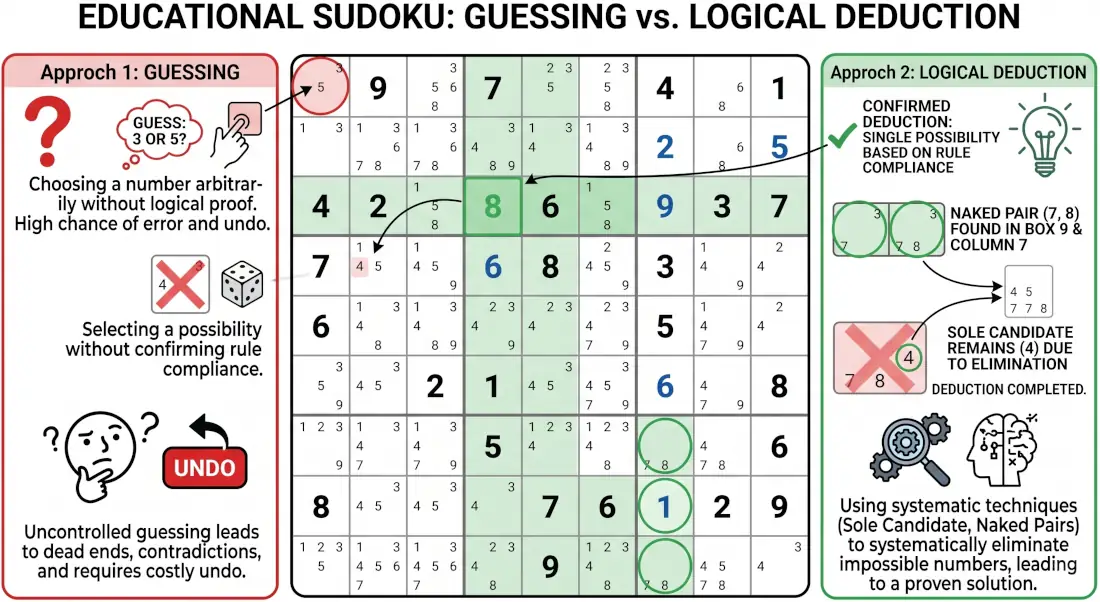
Many beginners think Sudoku requires guessing.
They get stuck, pick a number that "looks right," and hope for the best.
However, Sudoku is designed to be solved using logic. In fact, most easy and medium puzzles can be completed without making a single guess.
In this guide, you'll learn how to start solving Sudoku step by step using logic alone.
Does Sudoku Require Guessing?
No.
A properly designed Sudoku puzzle has enough clues to reach the solution through logical thinking.
Every number you place should be based on information already available in the puzzle.
Instead of asking:
"What number should I guess?"
Ask:
"What number is logically forced to go here?"
This simple change in mindset can dramatically improve your solving skills.
Start by Looking for Easy Numbers
When you first open a Sudoku puzzle, don't try to solve everything at once.
Instead, look for:
- Rows with only one or two empty cells
- Columns with only one or two empty cells
- 3×3 boxes that are nearly complete
These areas often contain obvious moves.
Example
Imagine a row that already contains:
1 2 3 4 5 6 7 8
The only missing number is:
9
No guessing is required.
The empty cell must be 9.
Use the Process of Elimination
Most Sudoku solving is based on eliminating impossible numbers.
Suppose you're looking at an empty cell.
You check:
- The row
- The column
- The 3×3 box
If a number already appears in one of these areas, it cannot go in the cell.
Eventually, only one possible number remains.
That's your answer.
Focus on One Area at a Time
A common beginner mistake is scanning the entire puzzle without a plan.
Instead, work systematically.
For example:
- Check every row.
- Check every column.
- Check every 3×3 box.
- Fill obvious numbers.
- Repeat the process.
Each new number creates additional clues elsewhere in the puzzle.
Look for Missing Numbers
Sometimes it's easier to think about what's missing rather than what can go in a cell.
For example, a 3×3 box may already contain:
1 2 3 4 5 6 8 9
The missing number is:
7
Now find the only cell in that box where a 7 can legally go.
This is often how players discover a Hidden Single — a number that has only one possible location within a row, column, or box.
Use Pencil Marks
When a cell has multiple possibilities, write them down. The simplest technique that uses pencil marks is the Naked Single. When only one candidate remains in a cell, you can place that number immediately.
For example:
2 5 8
This means the cell could be 2, 5, or 8.
These small notes are called pencil marks.
As you solve more of the puzzle, some candidates become impossible and can be removed.
Eventually, only one candidate remains.
Don't Place a Number Unless You're Sure
A good Sudoku habit is:
Only enter a number when you can explain why it belongs there.
If your reasoning is:
"I think it's probably a 6."
Don't place it.
If your reasoning is:
"Every other number is blocked, so this cell must be 6."
Then it's a logical move.
What to Do When You Feel Stuck
Getting stuck is normal.
When it happens:
- Recheck every row.
- Recheck every column.
- Recheck every box.
- Look for missing numbers.
- Update your pencil marks.
Many players discover a missed clue during a second scan.
Why Guessing Causes Problems
Guessing may seem faster, but it often creates bigger problems later.
A wrong guess can:
- Break Sudoku rules.
- Create contradictions.
- Force you to restart the puzzle.
- Hide the logical path to the solution.
The more you rely on logic, the more enjoyable Sudoku becomes.
The Beginner's No-Guess Routine
Whenever you start a new puzzle:
Step 1
Find rows with only one missing number.
Step 2
Find columns with only one missing number.
Step 3
Check every 3×3 box for missing numbers.
Step 4
Use elimination to narrow down candidates.
Step 5
Add pencil marks where necessary.
Step 6
Repeat the cycle.
Each pass through the puzzle usually reveals new opportunities.
Common Beginner Questions
What If I Can't Find Any Moves?
Double-check the puzzle and your pencil marks.
Most beginners overlook an easy clue somewhere on the board.
Is Guessing Ever Required?
For properly designed Sudoku puzzles, no.
Advanced puzzles may require advanced techniques, but they still rely on logic rather than random guessing.
How Do Experienced Players Solve Faster?
Experienced players recognize patterns more quickly.
They follow the same logical principles but can spot opportunities that beginners may miss.
Going Further
The key to solving Sudoku without guessing is simple:
- Look for missing numbers.
- Use elimination.
- Check rows, columns, and boxes carefully.
- Keep pencil marks when needed.
- Only place numbers when logic proves they belong there.
With practice, you'll begin to see patterns more easily and solve puzzles with confidence. The best Sudoku players don't guess—they follow the clues and let logic guide every move.
Once you've mastered the basics, explore our strategy guide to learn intermediate and advanced techniques like:
- Naked Pairs and Hidden Pairs
- Intersection Removal
- X-Wing and beyond
Each technique is a logical tool — no guessing required.