If you're new to Sudoku, the good news is that the rules are very simple.
Many people think Sudoku is a math game because it uses numbers, but that's not true. Sudoku is a logic puzzle. You don't need to do any calculations. You only need to place numbers according to a few basic rules.
Once you understand these rules, you'll be ready to solve your first puzzle.
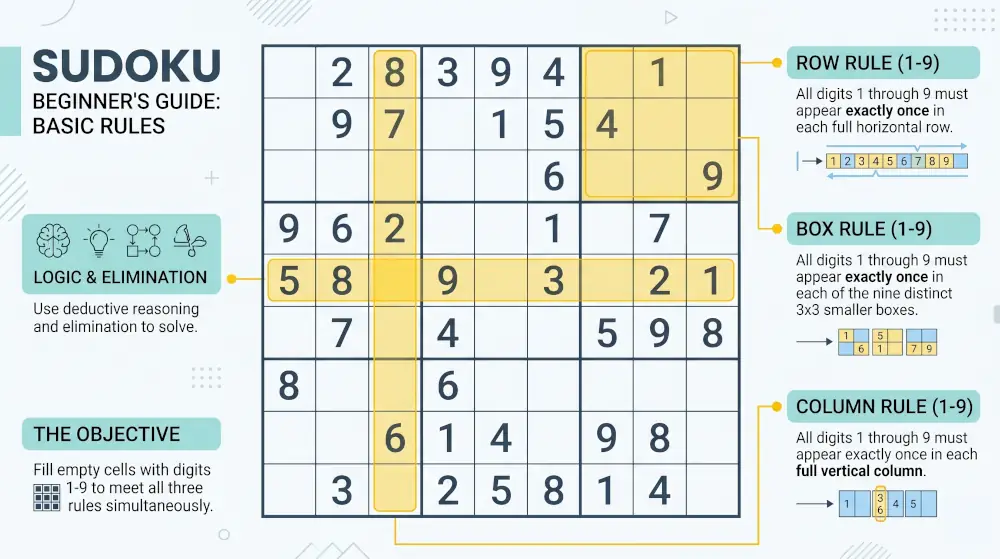
What Does a Sudoku Grid Look Like?
A standard Sudoku puzzle has:
- 9 rows
- 9 columns
- 9 smaller 3×3 boxes
Together, they create a grid with 81 cells.
Some cells already contain numbers. These are called given numbers or clues.
Your job is to fill the remaining empty cells.
Rule 1: No Repeated Numbers in a Row
Each row must contain the numbers 1 through 9 exactly once.
For example:
✅ Correct:
1 2 3 4 5 6 7 8 9
❌ Incorrect:
1 2 3 4 5 6 7 8 8
The number 8 appears twice, which breaks the rule.
Every row must contain all nine numbers without repetition.
Rule 2: No Repeated Numbers in a Column
Each column must also contain the numbers 1 through 9 exactly once.
For example, if a column already contains a 5, you cannot place another 5 anywhere else in that column.
When solving Sudoku, always check the column before entering a number.
Rule 3: No Repeated Numbers in a 3×3 Box
The grid is divided into nine smaller boxes.
Each box must contain the numbers 1 through 9 exactly once.
For example, if a box already contains the number 7, you cannot place another 7 inside that same box.
Many beginner mistakes happen because players forget to check the box after checking the row and column.
The Three Rules Work Together
Every number you place must satisfy all three rules at the same time:
- The number cannot already exist in the row.
- The number cannot already exist in the column.
- The number cannot already exist in the 3×3 box.
If even one rule is broken, the move is incorrect.
Example of a Valid Move
Imagine an empty cell.
You check:
- The row contains 1, 2, 3, 4, 5, 6, 7, and 8.
- The column does not contain 9.
- The 3×3 box does not contain 9.
The only missing number is 9.
Therefore, the cell must be 9.
This type of logical deduction is the foundation of Sudoku solving.
Why Sudoku Doesn't Require Math
Even though Sudoku uses numbers, mathematics is not involved.
You never:
- Add numbers
- Subtract numbers
- Multiply numbers
- Divide numbers
The numbers simply act as symbols.
You could replace them with letters A through I and the puzzle would work exactly the same way.
Sudoku is a game of logic, not arithmetic.
What Happens If You Break a Rule?
A single incorrect number can create problems throughout the puzzle.
For example:
- A duplicate number may block the correct solution.
- You may reach a point where no legal moves are possible.
- The puzzle may become impossible to finish.
That's why it's important to double-check every move.
How to Check a Number Before Placing It
Before writing a number in an empty cell, ask yourself three questions:
- Is this number already in the row?
- Is this number already in the column?
- Is this number already in the 3×3 box?
If the answer to all three questions is "No," the number may be a valid candidate.
The Goal of Sudoku
The goal is simple:
Fill every empty cell so that:
- Each row contains 1 through 9.
- Each column contains 1 through 9.
- Each 3×3 box contains 1 through 9.
When all cells are filled and all three rules are satisfied, the puzzle is solved.
Common Beginner Questions
Can a Number Appear More Than Once in the Puzzle?
Yes.
Each number appears many times across the entire grid.
The restriction only applies within individual rows, columns, and boxes.
Can There Be More Than One Correct Solution?
A proper Sudoku puzzle has only one valid solution.
If a puzzle can be solved in multiple ways, it is generally considered invalid.
Do I Need to Guess?
Easy Sudoku puzzles usually require no guessing.
Most puzzles can be solved by carefully applying the rules and using logical deduction.
Final Thoughts
Sudoku is built on just three simple rules:
- No repeated numbers in a row.
- No repeated numbers in a column.
- No repeated numbers in a 3×3 box.
That's all there is to it.
Once you understand these rules, you can start learning solving techniques and tackling increasingly difficult puzzles. Every Sudoku puzzle, from easy to expert, follows the exact same rules.
Ready to Solve?
Now that you know the rules, try our online solver. Enter any puzzle and see the step-by-step logical solution explained in plain language.